
Profiles of K–12 mathematics teachers’ innovative behavior: A latent profile analysis
##plugins.themes.bootstrap3.article.sidebar##
##plugins.themes.bootstrap3.article.main##
Abstract
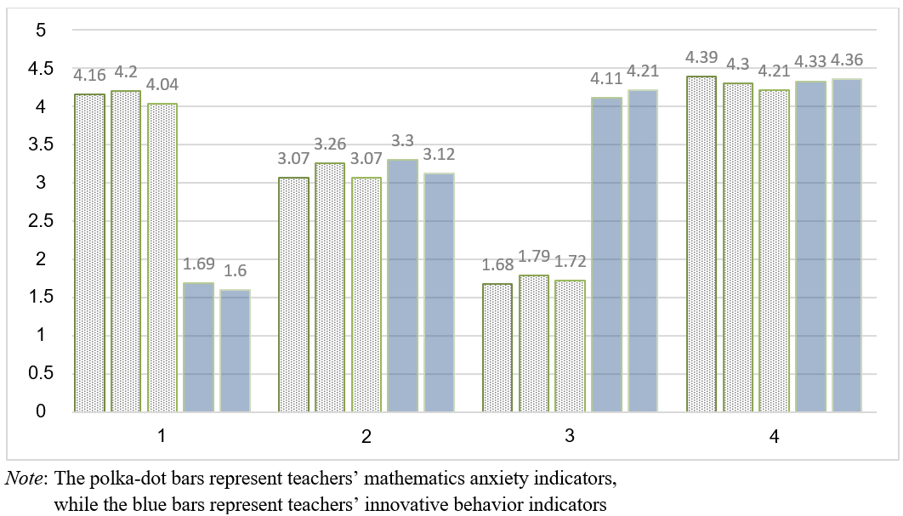
This study aims to identify the profiles of K–12 mathematics teachers’ innovative behavior in China using a latent profile analysis approach. Previous studies have mostly used variable-centered methods to examine factors associated with teachers’ innovative behavior, such as school support, professional knowledge, motivation, rewards, and anxiety. However, these approaches provide limited understanding of how mathematics anxiety and innovative behavior coexist within different groups of teachers. To address this gap, this study adopts a person-centered approach to classify mathematics teachers into distinct profiles based on their mathematics anxiety and innovative behavior. Survey data were collected from 336 mathematics teachers from primary, junior high, and senior high schools in China. Latent profile analysis was conducted to identify the optimal number of teacher profiles, and further analyses were used to examine whether the identified profiles differed in social influence, facilitating conditions, engagement, rewards, and technological-pedagogical-mathematical knowledge. The results identified four distinct teacher profiles. These profiles showed different combinations of mathematics anxiety and innovative behavior, indicating that teachers with similar professional contexts may still differ substantially in their emotional responses and innovation practices. Further comparison across profiles showed differences in social influence, facilitating conditions, engagement, rewards, and technological-pedagogical-mathematical knowledge, suggesting that mathematics teachers’ innovative behavior is shaped by the combined influence of emotional, professional, motivational, and contextual factors. Notably, the presence of Anxious–Innovative Teachers indicates that high innovative behavior can coexist with high anxiety, highlighting that innovation should not be interpreted only as a sign of confidence or psychological readiness.
##plugins.themes.bootstrap3.article.details##

This work is licensed under a Creative Commons Attribution-ShareAlike 4.0 International License.
The author is responsible for acquiring the permission(s) to reproduce any copyrighted figures, tables, data, or text that are being used in the submitted paper. Authors should note that text quotations of more than 250 words from a published or copyrighted work will require grant of permission from the original publisher to reprint. The written permission letter(s) must be submitted together with the manuscript.References
Abdullah, A. H., Soh, H. M., Mokhtar, M., Hamzah, M. H., Ashari, Z. M., Ali, D. F., Samah, N. A., Jumaat, N. F., Ibrahim, N. H., Surif, J., & Rahman, S. N. S. A. (2021). Does the use of smart board increase students’ higher order thinking skills (HOTS)? IEEE Access, 9, 1833–1854. https://doi.org/10.1109/access.2020.3042832
Angraini, L. M., Larsari, V. N., Muhammad, I., & Kania, N. (2023). Generalizations and analogical reasoning of junior high school viewed from Bruner's learning theory. Infinity Journal, 12(2), 291–306. https://doi.org/10.22460/infinity.v12i2.p291-306
Cage, E., & McManemy, E. (2022). Burnt out and dropping out: A comparison of the experiences of autistic and non-autistic students during the COVID-19 pandemic. Frontiers in psychology, 12, 792945. https://doi.org/10.3389/fpsyg.2021.792945
Darmawijoyo, D., Zulkardi, Z., Putri, R. I. I., Hapizah, H., & Syutaridho, S. (2025). How do students use mathematical reasoning to solve PISA-type mathematics problems based on making kite contexts? Infinity Journal, 14(4), 1065–1080. https://doi.org/10.22460/infinity.v14i4.p1065-1080
Desania, F., Sinaga, B., Lubis, A., & Syahputra, E. (2020). Analysis of students’ critical thinking skills through problem-based learning approach using HOTS questions in SMA N 13 Medan. International Journal of Scientific and Technology Research, 9(3), 131–137.
Fidalgo-Blanco, A., Martinez-Nuñez, M., Borrás-Gene, O., & Sanchez-Medina, J. J. (2017). Micro flip teaching ‒ An innovative model to promote the active involvement of students. Computers in human Behavior, 72, 713–723. https://doi.org/10.1016/j.chb.2016.07.060
Gill, S. S., Xu, M., Patros, P., Wu, H., Kaur, R., Kaur, K., Fuller, S., Singh, M., Arora, P., Parlikad, A. K., Stankovski, V., Abraham, A., Ghosh, S. K., Lutfiyya, H., Kanhere, S. S., Bahsoon, R., Rana, O., Dustdar, S., Sakellariou, R., . . . Buyya, R. (2024). Transformative effects of ChatGPT on modern education: Emerging era of AI Chatbots. Internet of Things and Cyber-Physical Systems, 4, 19–23. https://doi.org/10.1016/j.iotcps.2023.06.002
Gurzynski-Weiss, L., Long, A. Y., & Solon, M. (2015). Comparing interaction and use of space in traditional and innovative classrooms. Hispania, 98(1), 61–78. https://doi.org/10.1353/hpn.2015.0028
He, Y., Wijaya, T. T., Habibi, A., chen, H., & Gao, M. (2025). Exploring the relationship between teacher and parent support and students’ noncognitive outcomes via Latent Profile Analysis. Humanities and Social Sciences Communications, 12(1), 1–9. https://doi.org/10.1057/s41599-025-04422-w
Hendriana, H., Ristiana, N., Kusaka, S., Peni, N. R. N., & Prahmana, R. C. I. (2025). Integrating indigenous number systems and indefinite units into mathematics learning: A study on Javanese language and culture. Infinity Journal, 14(3), 797–816. https://doi.org/10.22460/infinity.v14i3.p797-816
Hidayat, W., & Aripin, U. (2023). How to develop an e-LKPD with a scientific approach to achieving students' mathematical communication abilities? Infinity Journal, 12(1), 85–100. https://doi.org/10.22460/infinity.v12i1.p85-100
Hidayat, W., Aripin, U., & Widodo, S. A. (2025). Integration of ethno-modelling and 3N: An innovative digital worksheet framework to enhance students' mathematical critical thinking skills. Infinity Journal, 14(4), 1019–1042. https://doi.org/10.22460/infinity.v14i4.p1019-1042
Hunter, J., Miller, J., Choy, B. H., & Hunter, R. (2020). Innovative and powerful pedagogical practices in mathematics education. In J. Way, C. Attard, J. Anderson, J. Bobis, H. McMaster, & K. Cartwright (Eds.), Research in Mathematics Education in Australasia 2016–2019 (pp. 293–318). https://doi.org/10.1007/978-981-15-4269-5_12
Klaeijsen, A., Vermeulen, M., & Martens, R. (2018). Teachers’ innovative behaviour: The importance of basic psychological need satisfaction, intrinsic motivation, and occupational self-efficacy. Scandinavian Journal of Educational Research, 62(5), 769–782. https://doi.org/10.1080/00313831.2017.1306803
Lee, P.-C., Lin, C.-T., & Kang, H.-H. (2016). The influence of open innovative teaching approach toward student satisfaction: a case of Si-Men Primary School. Quality & Quantity, 50(2), 491–507. https://doi.org/10.1007/s11135-015-0160-x
Li, K., Wijaya, T. T., Chen, X., & Harahap, M. S. (2024). Exploring the factors affecting elementary mathematics teachers’ innovative behavior: an integration of social cognitive theory. Scientific Reports, 14(1), 1–14. https://doi.org/10.1038/s41598-024-52604-4
Mandala, A. S., Anwar, L., Sa'dijah, C., & Zulnaidi, H. (2025). Development of mobile augmented reality-based geometry learning games to facilitate spatial reasoning. Infinity Journal, 14(2), 323–348. https://doi.org/10.22460/infinity.v14i2.p323-348
Marhaeni, N. H., Arnal-Palacián, M., & Irfan, M. (2024). Interactive math comics: An analysis of Indonesian and Spanish students’ responses. Infinity Journal, 14(1), 143–162. https://doi.org/10.22460/infinity.v14i1.p143-162
Muñoz, A. J., & González, J. (2017). Percepción de estrés y perfeccionismo en estudiantes adolescentes. Influencias de la actividad física y el género [Perception of stress and perfectionism in adolescent students: Influences of physical activity and gender]. Ansiedad y Estrés, 23(1), 32–37. https://doi.org/10.1016/j.anyes.2017.04.001
Musgrove, M. M. C., & Schussler, E. E. (2022). The Ph.D. panic: Examining the relationships among teaching anxiety, teaching self-efficacy, and coping in biology graduate teaching assistants (GTAs). Journal of Research in Science, Mathematics and Technology Education, 5(SI), 65–107. https://doi.org/10.31756/jrsmte.114SI
Mutlu, A. K., & Solhi, M. (2024). Unveiling the interplay between EFL teachers’ cognitive flexibility, emotion regulation, and foreign language teaching anxiety: A structural equation modeling approach. Learning and Motivation, 87, 102022. https://doi.org/10.1016/j.lmot.2024.102022
Nylund, K. L., Asparouhov, T., & Muthén, B. O. (2007). Deciding on the number of classes in latent class analysis and growth mixture modeling: A Monte Carlo simulation study. Structural Equation Modeling: A Multidisciplinary Journal, 14(4), 535–569. https://doi.org/10.1080/10705510701575396
OECD. (2022). Programme for international student assessment (PISA) 2022 : Insights and interpretations. OECD Publishing.
OECD. (2025). Unlocking high-quality teaching. OECD Publishing. https://doi.org/10.1787/f5b82176-en
Quan, Y. (2025). The role of AI-driven feedback in fostering growth mindset and engagement: A self-determination theory perspective. Learning and Motivation, 92(1), 102192. https://doi.org/10.1016/j.lmot.2025.102192
Resende, M., & Cirillo, M. Â. (2025). Simulation studies of information criteria used in the selection of multilevel structural equation models. Pesquisa Operacional, 45, e295146. https://doi.org/10.1590/0101-7438.2025.045.00295146
Rohaeti, E. E., Hendriana, H., & Irfan, M. (2023). Doing mathematics intelligently and having good character through Simpatik learning. Infinity Journal, 12(1), 179–192. https://doi.org/10.22460/infinity.v12i1.p179-192
Santana-Ramírez, H. F., Salgado-Beltrán, G., García-García, J., & López-González, A. (2025). Alternative conceptions about proportional reasoning in high school students. Infinity Journal, 14(3), 781–796. https://doi.org/10.22460/infinity.v14i3.p781-796
Setambah, M. A. B., Adnan, M., Zaini, S. H., Mujiasih, M., Hidayat, R., Ibrahim, M. A., & Hanazono, H. (2024). Impact of "Donkey", "Snap" dan "King" (DSK) non-digital gamification cards on fourth-grade students' math performance in fractions. Infinity Journal, 13(1), 175–196. https://doi.org/10.22460/infinity.v13i1.p175-196
Sofyan, S., Habibi, A., Sofwan, M., Yaakob, M. F. M., Alqahtani, T. M., Jamila, A., & Wijaya, T. T. (2023). TPACK–UotI: the validation of an assessment instrument for elementary school teachers. Humanities and Social Sciences Communications, 10(1), 1–8. https://doi.org/10.1057/s41599-023-01533-0
Tak, C. C., Zulnaidi, H., & Eu, L. K. (2025). Factors influencing the attitude of undergraduate students towards mathematical reasoning: An approach using AMOS-structural equation modelling. Infinity Journal, 14(1), 109–124. https://doi.org/10.22460/infinity.v14i1.p109-124
Valtonen, T., Sointu, E., Kukkonen, J., Kontkanen, S., Lambert, M. C., & Mäkitalo-Siegl, K. (2017). TPACK updated to measure pre-service teachers’ twenty-first century skills. Australasian Journal of Educational Technology, 33(3), 15–31. https://doi.org/10.14742/ajet.3518
Vanstone, D. M., & Hicks, R. E. (2019). Transitioning to university: Coping styles as mediators between adaptive-maladaptive perfectionism and test anxiety. Personality and Individual Differences, 141, 68–75. https://doi.org/10.1016/j.paid.2018.12.026
Wah, L. L., & Hashim, H. (2021). Determining pre-service teachers’ intention of using technology for teaching english as a second language (ESL). Sustainability, 13(14), 7568. https://doi.org/10.3390/su13147568
Westphal, A., Schulze, A., Schlesier, J., & Lohse-Bossenz, H. (2024). Who thinks about dropping out and why? Cognitive and affective-motivational profiles of student teachers explain differences in their intention to quit their teaching degree. Teaching and Teacher Education, 150, 104718. https://doi.org/10.1016/j.tate.2024.104718
Wijaya, T. T., Hidayat, W., Hermita, N., Alim, J. A., & Talib, C. A. (2024). Exploring contributing factors to PISA 2022 mathematics achievement: Insights from Indonesian teachers. Infinity Journal, 13(1), 139–156. https://doi.org/10.22460/infinity.v13i1.p139-156
Wijaya, T. T., Yu, Q., Cao, Y., He, Y., & Leung, F. K. S. (2024). Latent profile analysis of AI literacy and trust in mathematics teachers and their relations with AI dependency and 21st-century skills. Behavioral Sciences, 14(11), 1008. https://doi.org/10.3390/bs14111008
Wu, D., Zhou, C., Liang, X., Li, Y., & Chen, M. (2022). Integrating technology into teaching: Factors influencing rural teachers’ innovative behavior. Education and Information Technologies, 27(4), 5325–5348. https://doi.org/10.1007/s10639-021-10815-6
Xu, J. (2024). Student-perceived teacher and parent homework involvement: Exploring latent profiles and links to homework behavior and achievement. Learning and Individual Differences, 109, 102403. https://doi.org/10.1016/j.lindif.2023.102403
Yuan, Z., Liu, J., Deng, X., Ding, T., & Wijaya, T. T. (2023). Facilitating conditions as the biggest factor influencing elementary school teachers’ usage behavior of Dynamic Mathematics Software in China. Mathematics, 11(6), 1536. https://doi.org/10.3390/math11061536
Zulnaidi, H., & Zamri, S. N. A. S. (2017). The effectiveness of the GeoGebra software: The intermediary role of procedural knowledge on students’ conceptual knowledge and their achievement in mathematics. Eurasia Journal of Mathematics, Science and Technology Education, 13(6), 2155–2180. https://doi.org/10.12973/eurasia.2017.01219a